
You have never had chances to deep-practice high stakes conversations.
Situational coaching for founders, from someone highly tactical who has been there and done that and still builds and sells for a living. Five-time founder, seven fundraises, five companies and two turnarounds. Bring me the conversation that's open right now.
Pocket Advisor: just-in-time support for founders. Text and Slack while it's open, a call a month, twice-monthly dojo.
Your Week
You're going to have these dramas weekly.
Conversations after the pitch
The deck landed and they liked it. Now there's a second meeting with two people who weren't in the first one, and one of them will say something dogmatic, almost an attack, to see how you respond. They're testing you, not your message.
The number VCs won't say first
Three polite emails in and neither one of you has said a number. Most people who invest aren't the ones to come up with the number. You probably need to lead that, and going first feels like showing your hand. Paste the draft before you send it. Back comes the number to lead with and the sentence that carries it.
Downgraded to the prospect's number 2
His number two has the thread now and wants a call without your buyer. You were founder to exec and have been pawned into an employee-level over/under relationship. Let's figure out how you'll respond and elevate the conversation to a decision.
You're already doubting equity assignments
Your initial partners/co-founder aren't doing what you thought for equity, or are asking for it and you don't know how or whether to assign it and under what structure. These conversations aren't easy and when you succeed, your sticky cap table makes the difference. I'll help you navigate.
These enterprise deals take forever
What you thought was your validation customer seems to have lost momentum and you're wondering what you did wrong, doubting the whole product and company.
You want to hire a sales person
The product is your baby. It's good enough. Time to hire a sales person, right? Wrong. The first sales hire often makes or breaks a startup. Here's how to make it less expensive, know the time is right, and ensure they're walking into a working funnel. Founders have to figure out the first version of everything.
I'm here for your firsts
So you show up like it isn't your first time.
A pro soccer player I co-founded a business with once coached me: "don't let them know it's your first time." He was talking about scoring a goal, but we channeled that into visualization and practice of key moments in raising funds, closing deals, and growing the startup.
Don't make these up. Don't take advice from someone who isn't thinking like an owner and knows your current stage.
After the pitch
Nobody invests like on Shark Tank.
YouTube and LinkedIn worship the pitch and the deck. I've raised millions without even opening the deck.
They engage in multiple follow-on meetings where they probe you this way and that way, and if you had a slide deck, it's an entry in the door. My dad was a 22-year Army officer. He taught me that all planning is for the first ten seconds of combat, and from that point situational judgment is supposed to take over.
Communication is the same. Nobody's got reps or training in what happens after you state your first position. So when somebody says something harsh, or an objection, it's not a fight. They just revealed their success criteria. Let me find out more about that.
Your relational conversational skills and curiosity are the only way a founder navigates the conversations you context-switch through in a week: a gatekeeper blocking the door, the VC pitch you didn't realize was just to the analyst, the referral you're not sure how to follow up, and the major negotiation on a quick-moving deal.

The advice you're getting
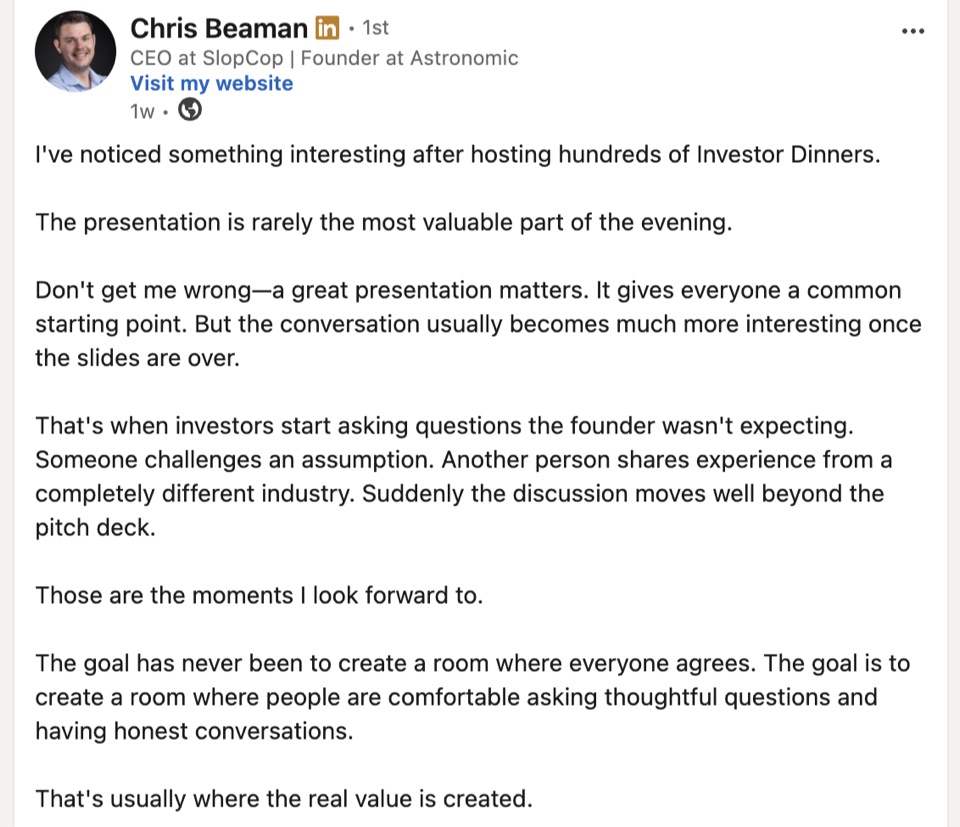
Off-stage advice is deadly
When I speak at accelerators, I'm told it's the best presentation. Usually that's because I'm sharing messy actual screenshots, spreadsheets, Trello boards, and so on, then helping each founder figure out how they can get 3-5 key convos by tomorrow night. Real founder stuff.
Most people training at accelerators have never built a business. If you worked at a startup but were employee 7, you literally don't know how to start one and your advice WILL BE off-stage. It's for after the value-fit is established and you start getting to do seed stage mechanics, or growth-stage spend.
What you get reps in
The seven conversations you need a mental model to navigate
The seven conversation types
The three rules of engagement under all of them
After the pitch
These skills are caught, not taught. You literally need practice to cultivate real-time adaptational skills and language that are executive, not junior. If you're saying these things, you need it:
The Growth Machine
Only you can build your first funnel
There are several key components of the growth machine that the founder MUST work out before adding brains/people to the team. It's the complete follow through. I've taught it to many who went on and raised millions and grew profitable businesses or had exits.
1. The brain
One card per ICP theory, and you might have two to five. Product, marketing, and sales all read from this card until product-market fit.
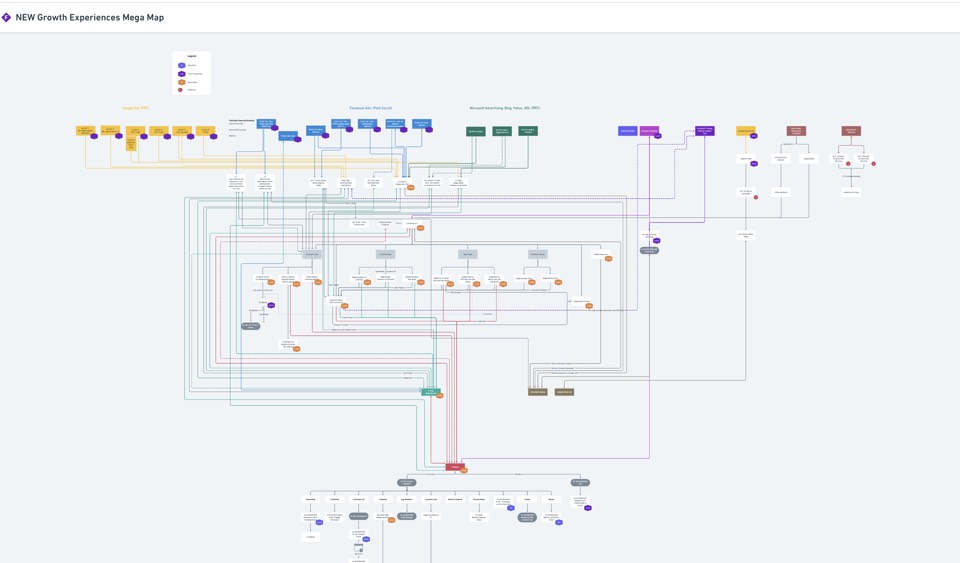
2. The funnel, drawn for one company
Sit down and draw yours. Just by looking at it, people make self-optimizing statements.
3. Growth bets, on the board
This sprint
Growth bets: planned, testable, concrete action against specific parts of your funnel, on time-based sprints. This is the way to incremental growth.
Under the machine, the company side: people strengths, a scored process list with a face on each process, squads formed from a problem statement, a project board with a Slack channel per initiative.
The right tool at the right time
You need just-in-time help on predictable dramas
What I wish I'd had as a founder: not macro advice all the time from "strategic advisors" and senior executives. Instead, I could've used "in the trenches" advice on exact items I wasn't sure of, where I could get the 5-minute version and ask for principles if I needed them.
Here are some of the predictable dramas I've got a playbook for, the second you need it. Sure, you could try and absorb all this in a class. But if you're a founder, you probably learn by doing. That's where I'm a text or Slack away.
A month of Pocket Advisor
Everything that's in the month.
The founders
Isaiah is an invaluable strategic resource for me who is always available when I need him. He helps me think through (and sometimes play out in real time) important decisions on how to go from 0 to 1 in various aspects of being a SaaS founder.
David Refaeli-Berman, founder and CEO, EmailStrategist.ai
Isaiah's coaching has transformed my way of thinking. I approach every problem differently. If only he could coach my teenagers too! I've learned to look at the problem before the solution, gaining the customer perspective on value instead of guessing at pricing, and succeeded at switching from guessing to certainty in customer negotiations.
Imran Mosthafa, co-founder and CTO, Kensink
Isaiah is the single smartest person I have ever met.
Gary Stephens, co-founder, Vendidit
Who's on the other end
I have sat on your side of that email, and I have sat on the side that answers it.
I founded and funded many companies, Skribe.ai (legal depositions AI), Vendidit (marketplace backed by Shark Tank billionaire), Pinwheel.com (global healthy kid phone), statUP (sports tech), Towny (B2B2C local business app), and more where I was on the founding team. I designed the go-to-market and the launch funnels for the products I sold, and I have personally closed $35M+ in deals with these models. I have held every seat in a startup and started every department, and I have taken a startup through all three stages and through an acquisition. I've also placed pre-seed and seed investments.
So when you paste me an email, the man reading it has answered that one and navigated it from both sides. I know how enterprise buyers and consumers think, and everyone in between. I know which tactics work, which don't, and which need experimentation.
On the other side of it: three years with the prison debate team at the Huntsville Unit, a Series A product leader through their first $10B-account negotiation, and 250 key account managers coached at a Fortune 500 medical technology company.
I've coached specific sales conversations, presentations, negotiations, and pitches for pro athletes you've heard of, a Shark Tank billionaire, enterprise sales teams, customer success teams, and health/wellness teams who reached 40-80% close rates with my coaching. And I've coached thousands of students and hundreds of founders.
The month
$1,000 a month, cancel any month.
It's $1,000 a month, paid up front on the first, and you can cancel any month. A month is the text line, one scheduled call, the five minute calls when something's live, the Founders Dojo twice a month, office hours, Founders Love Sales with the materials and the AI coach, and the founders' Slack. If it isn't earning its thousand, tell me and we're done, no hard feelings. Bring me one conversation and I'll work it with you on the call and say your number out loud.
No revenue and no funding yet: $250 a month plus equity, set with you on the call, and the month goes to cash the first time you have revenue or you close a round.
Twenty-five minutes
Bring the conversation that's in front of you.
Bring one real conversation that's in front of you this month. An investor's second meeting, a partner's number two, a first hire, a prospect who went quiet. Twenty-five minutes, and we work it on the call, the way we'd work it on text. At the end I tell you whether Pocket Advisor is the right thing or whether to go run the course and come to the Dojo. I say the number out loud.