
What I run is a sales dojo. Your sellers, one room, every week, drilling the calls they actually ran, with me playing the buyer. The person who sent you here has watched that work. What it does for your team is put a named skill in a seller's mouth and let you hear it while the call is still live, not in a report three days later.
Whoever sent you here did you a favor. Put their name in the box, because I like knowing.
What the sales dojo is
Your team's real calls are the curriculum.
Your sellers bring calls they actually ran, or calls they have tomorrow. I play the buyer. Somebody starts, and about ninety seconds in I stop them mid-sentence and name what just happened, because a correction three days later in a coaching form lands on nobody. Then they run it again, right there, with the correction in their mouth. Reset. Reposition. Try it again. Do it this way. Skills are caught, not taught. Week one we build a scorecard off their own recordings, with named skills and a starting level per person, so movement is something you can point at. And your closest manager sits in the chair next to me the whole time, learning to run the drill in the same language, because I grade the conversation, never the person.
How it runs
Name it. Baseline it. Track it.
THE BASELINE
Your sellers send me recordings of their own calls. I build the board from those, then sit at it with you and your closest manager, and we come out with a scorecard, named skills, and a level per person.
THE PODS
Three to five people at a time, drilled on their own calls with me playing the buyer. Small enough that everybody talks and nobody hides in a group session.
THE STANDING DOJO
One room a week, everybody who came through the pods. Your live deals are the curriculum. The call somebody has tomorrow gets rehearsed. The call somebody lost gets replayed and then drilled until it's theirs.
THE WRITTEN DEBRIEFS
You pick the calls. What comes back is a written debrief of what happened in the conversation and what the redo sounds like in that rep's own register, so the correction is on paper in their words.
THE MANAGER HOUR
Your manager brings a live call and runs the drill himself while I watch. Transference, not dependency. By the end he runs Thursday without me.
THE READ
New recordings against the week-one scorecard, on the board, with you. Where each person started, where they are, what your manager runs next. Graduation is the goal from day one.
What changes in your sellers
Six specific things move, and your manager can point at where each one happened.
Before
After
Stuck between meandering through endless questions and pitching too early. Where's the line?
Executive, adaptive presence. You know when you've earned the right to speak.
Transactional conversations. Order takers on one end, "closers" out of a Grant Cardone program on the other.
Strategic conversations that land a problem statement the buyer answers with "that's right."
Stalled at the gatekeeper, or bickering with them.
Gatekeepers building your case inside their own organization and opening the door.
Commoditized price dramas. Procurement whittling you down on weak comparisons.
Firm negotiation with generous intent. Eighteen factors on the table, not two.
Decks and demos as walkthroughs. Feature, feature, feature, "any questions?"
Demos that reveal the buyer's decision criteria, one concept at a time, watching each one land.
Deals that die mysteriously after a great meeting. Everyone said yes.
You can tell a cognitive yes from an emotional one, and you stop counting the first as pipeline.
What we drill
These are the skills, in the order they get taught.


The three rules of engagement for trust
One point per turn, open questions, following the clues. Drilled first because nothing else works without them.
Directed discovery
Steering toward the problem that matters instead of running a list of questions.
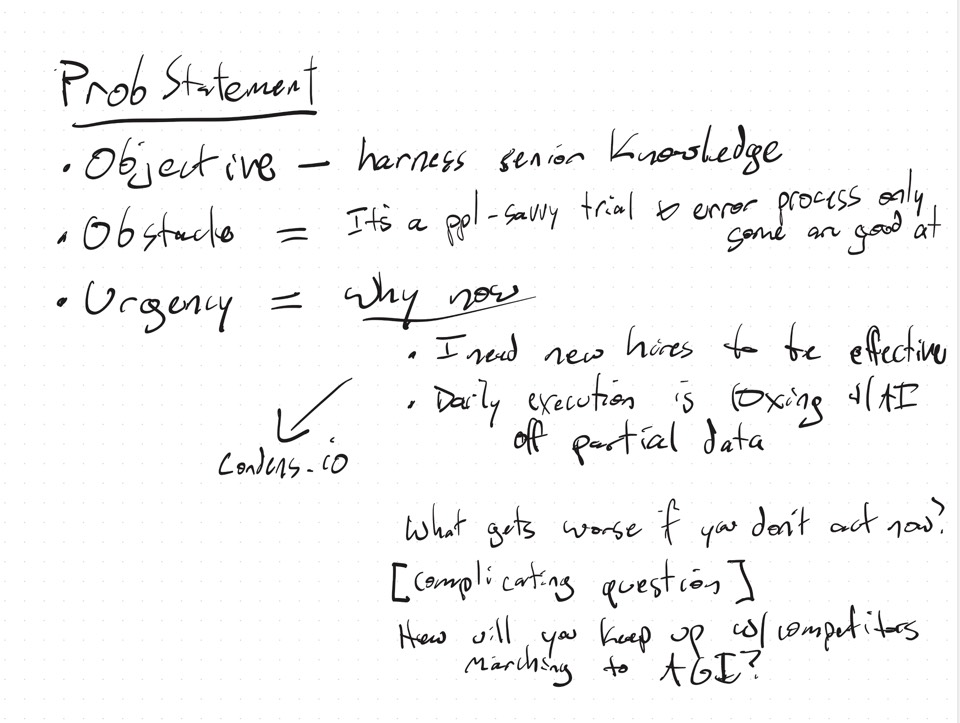
The problem statement
Saying their problem back better than they said it, until they answer "that's right."
The Discovery Wheel
Objective, Approach, Results. Where you are on the wheel tells you what to ask next.
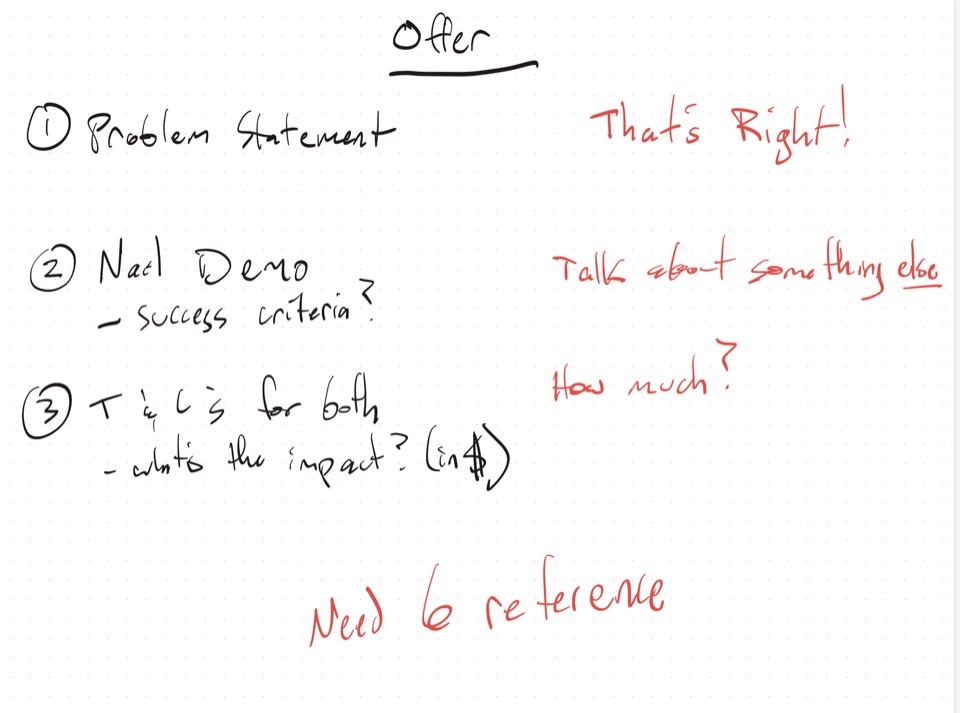
The four-part offer
Problem statement, demo against their success criteria, terms, and the signals that each one landed.
Launch Frame
A proposal on the table in front of executives in ninety seconds, then an activated executive conversation.
Framing, Random Access Memory Not Walkthroughs, and Handling Executive Probing
The three skills Launch Frame teaches: set the frame, answer the deck in any order, take the hard question.
Negotiation with generous intent
Firm on your side, generous about theirs, eighteen factors on the table instead of price.
The cognitive yes and the emotional yes
Hearing which one you just got, so a great meeting stops meaning a forecast.
Dropping guard
The brain science of the emotional wall, and how you get to the same side of the table.
Who is running the room
I sold before I coached.
I have personally closed $35M+ in deals with these models. I won a $1M+ contract head-to-head against a McKinsey consultant. I ran $32M in federal capture and built a federal division from 1 to 70 people. I coached 250 key account managers at a Fortune 500 medical technology company. Their most senior seller closed the Veterans Affairs Administration. No company has started a dojo and stopped by choice. Most reps get one to three redos a month from coaching. In a dojo they get five to fifteen a session.
He sells
He coaches
The first call
Bring me what is actually happening on your calls.
You tell me what's happening on your calls, I ask questions, then I say out loud what I would run with your team and what it costs. Bring a recording and we'll pull it apart together on the call. If what I hear sits upstream of the conversations, in your offer or your territory, I'll tell you straight and let you go.