
The Sales Leak Diagnostic
You send five to ten recorded calls from deals that should have moved and didn't. I read all of them, write up the three most revealing line by line, and then we spend 90 minutes at the whiteboard, live in Austin or on Zoom. Three of those moments are on this page. Read one before you send anything.
The part you can't see
You can point at the stage where deals go quiet. You cannot point at the sentence.
Your pipeline report already told you where it happens. One stage, same stage, deal after deal. Everybody said the call went well. The tape sounds friendly and professional. And then the thread goes cold and the forecast gets soft and somebody in the room says we think it's a discovery problem, and you know that's a guess, and so does everyone else at that table. The why isn't in the report. It's inside the conversations, in specific turns, in the words your rep used and the ones the buyer used back. Your rep took a no at face value because he had no move after it. He asked the technical follow instead of the strategic one and nobody ever told him why it cost him the deal. He answered a procurement question like a vendor answering a form. Your people are showing up like victims of the buyer's process instead of strategic partners in it, and that shows up as one thing on your side of the house: deals that are too small and too slow.
What I'm not coming in to do
I don't even care what your sales process is.
Most sales training fails in one of two ways. Theory that doesn't translate to practice: somebody redoes your sales process, deciding which calls to make and which psychology triggers to pull so deals close. Hype that doesn't translate to practice: somebody comes in with motivation, and Monday looks the same. My belief is that the people executing your process aren't doing it at an elevated conversational level. They don't have the mental models to adapt in a real-time sales conversation, so they default to scripts, anxious techniques, and sales tropes.
The missing ingredient is human skill infusion, and most don't do it because of how hard it is. You have to be a practitioner and a coach, with an eye for brain science, conversational technique, and the individual personality in front of you. Another book or another pep talk doesn't solve this. I come in for the raw skill sets and competencies underneath, and for the transference: everything your training, your enablement, and your marketing already built, turned into what your team can actually execute in the room.
How it works
Three steps. Most of the work happens before we're on the board together.
You send five to ten recorded calls or transcripts from deals that should have moved and didn't. You pick them, because you already know which stage they died at. Tell me who's selling too: how long they've been at it, what they sell, who's in the room when the buyer decides. That's the whole ask.
I read every one against the named skills. The three most revealing get a full written report, line by line: the timestamp, the buyer's line, your rep's line, the skill missing right there, and the redo. Written the way I coach, with the buyer's psychology at that point named. The pattern across the other calls comes back too.
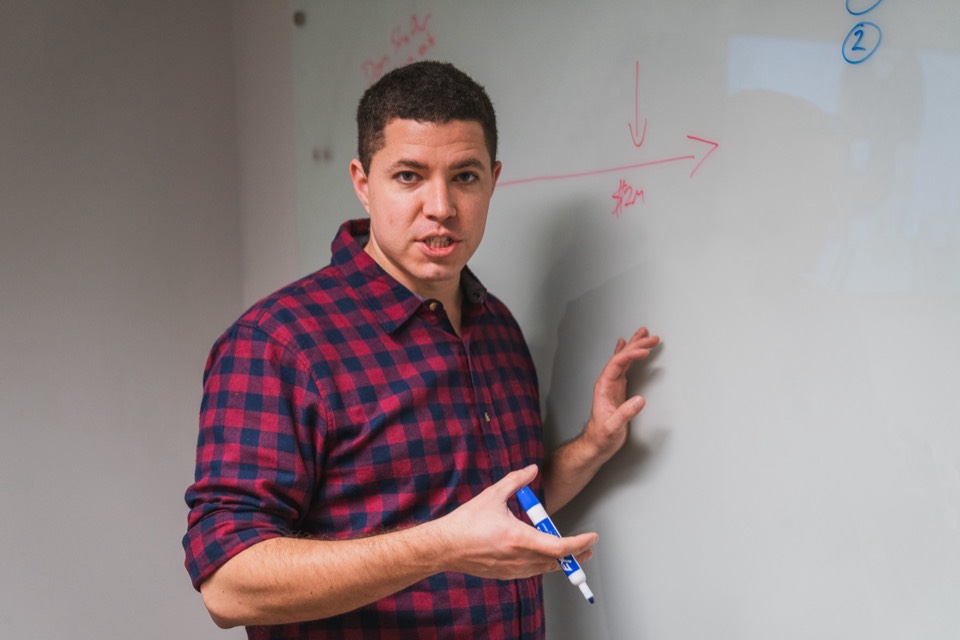
90 minutes at the whiteboard, live in Austin or on Zoom. First the handoffs: where the deal moves between marketing, sales, product, and delivery, and who owns each move. Then the moments. Then the prescription: which named skills, in what order, for which people. Board photos in your inbox within 24 hours.
You bring the deals. I name the skills. I bring the models. You bring the real deals. We work it live, the same way I coach.
What I hold the calls against
These are the ten I start with. Every transcript gets read against them, turn by turn, and the miss gets named with the skill it belongs to, so your team hears a name instead of nice call, be more consultative. There are hundreds more behind these ten. Ten is what fits on a board in 90 minutes. Most teams don't need more.
Three moments
This is what it looks like when the feedback is specific enough to use.
Three real moments from coaching sessions, companies normalized. Each one shows the line that was said, the miss, what I said in the room, and the redo. Start with the first one: an AE eleven and a half minutes into a call who still hasn't asked a question that moves the deal. If you want the long version, read the sample report below, a full 24-minute call graded the same way. This is what a page of the written report looks like.
What you leave with
A diagnosis: the specific moments where the conversation stayed transactional when it needed to be strategic, and the skill missing at each one. The named skills your team needs, in priority order, so you know what to drill first and what waits until next quarter. A plan that spans every function it touches, because a sales training won't touch a broken handoff between marketing and sales. Photos of every board within 24 hours, so you can send it to your CFO without rewriting it. Some teams take the plan and run it themselves. Some ask me to drill it with them in a dojo. If a dojo is the prescription I'll tell you what its first cycle should drill. If it isn't, I'll tell you that too.

The guarantee
If the diagnosis doesn't name the moments and the skills precisely enough for you to act on Monday, don't pay me.
Proof
250 key account managers coached at a Fortune 500 medical technology company.
Their most senior seller closed the Veterans Affairs Administration.
A San Francisco physical therapy clinic's front-desk conversations went from roughly 20% to 40-50% close rates.
Read a sample report before you buy. A real 24-minute call, graded moment by moment.
Read the sample reportBook the Diagnostic
Two ways in. Same 90 minutes on the board, same diagnosis, different amount of evidence underneath it.
Pick the one that matches how many calls you've got, pay, and the next page puts you on my calendar.
The Sales Leak Diagnostic
$1,250
Five to ten calls read against the named skills, three full written reports line by line, 90 minutes at the whiteboard, board photos.
Pick your time on the next page. Send the calls once you're booked. Reports come before we meet, board photos within 24 hours after.
Secure checkout by Stripe
The Sales Skills Diagnosis
$400-450
For a leader with two or three calls, or one rep he's worried about. Same 90 minutes, same diagnosis, same prescription. No written reports.
Pick your time on the next page. Send the transcripts once you're booked. Board photos within 24 hours.
$350 if a NEXT Preferred Partner sent you. Book the partner rate
Secure checkout by Stripe
The guarantee
If the diagnosis doesn't name the moments and the skills precisely enough for you to act on Monday, don't pay me.
Questions
Two or three recordings or transcripts of deals that should have moved and didn't, plus who was on your side of each. Strip patient information; I only need the conversation.
The leader who can act on the plan, and the manager closest to the reps. Bring one rep if you want them to hear it firsthand.
Good. Challenger, Sandler, MEDDIC, whatever you run names the steps. We find the skill inside the step that isn't transferring. It makes what you already have more powerful.
Count your calls. If you've got two or three and the question is one rep, take the Diagnosis. If deals are going quiet at the same stage across several reps, take the Diagnostic, because the pattern only shows up across calls. If you have to sell this plan to a CFO or a board, take the Diagnostic. The written reports are the part you forward.